What Is Amazon FBA?
Amazon FBA (Fulfilled by Amazon) is a business model that allows sellers to ship their products from a supplier directly to Amazon’s warehouses. With FBA, your products are stored in Amazon’s fulfillment centers, where you can list them for sale by adding your pricing and product details.
Amazon then handles key operations such as packaging, shipping, and customer service. Your main responsibility is to send your products to Amazon and manage your listings.
What You Need to Start Selling with Amazon FBA
Starting an Amazon FBA business requires several foundational elements. While the model simplifies fulfillment and logistics, sellers should prepare key components before launching their first product.
An Amazon Seller Account
To operate on Amazon, you must first create a seller account. This account provides access to Amazon Seller Central, where listings, inventory, payments, and performance metrics are managed.
A Product to Sell
Product selection is one of the most critical decisions. Successful sellers typically look for items with consistent demand, manageable competition, and sustainable profit margins.
A Sourcing Strategy (Supplier / Manufacturer)
Once a product idea is identified, sellers need a reliable sourcing approach. This often involves working with manufacturers or suppliers capable of meeting quality standards, customization needs, and production timelines.
Shipping & Logistics Planning
Inventory must be transported from the supplier to Amazon’s fulfillment centers. This process may include production lead times, freight arrangements, customs clearance, and warehouse receiving procedures.
Product Identifiers (UPC / EAN / GTIN Where Applicable)
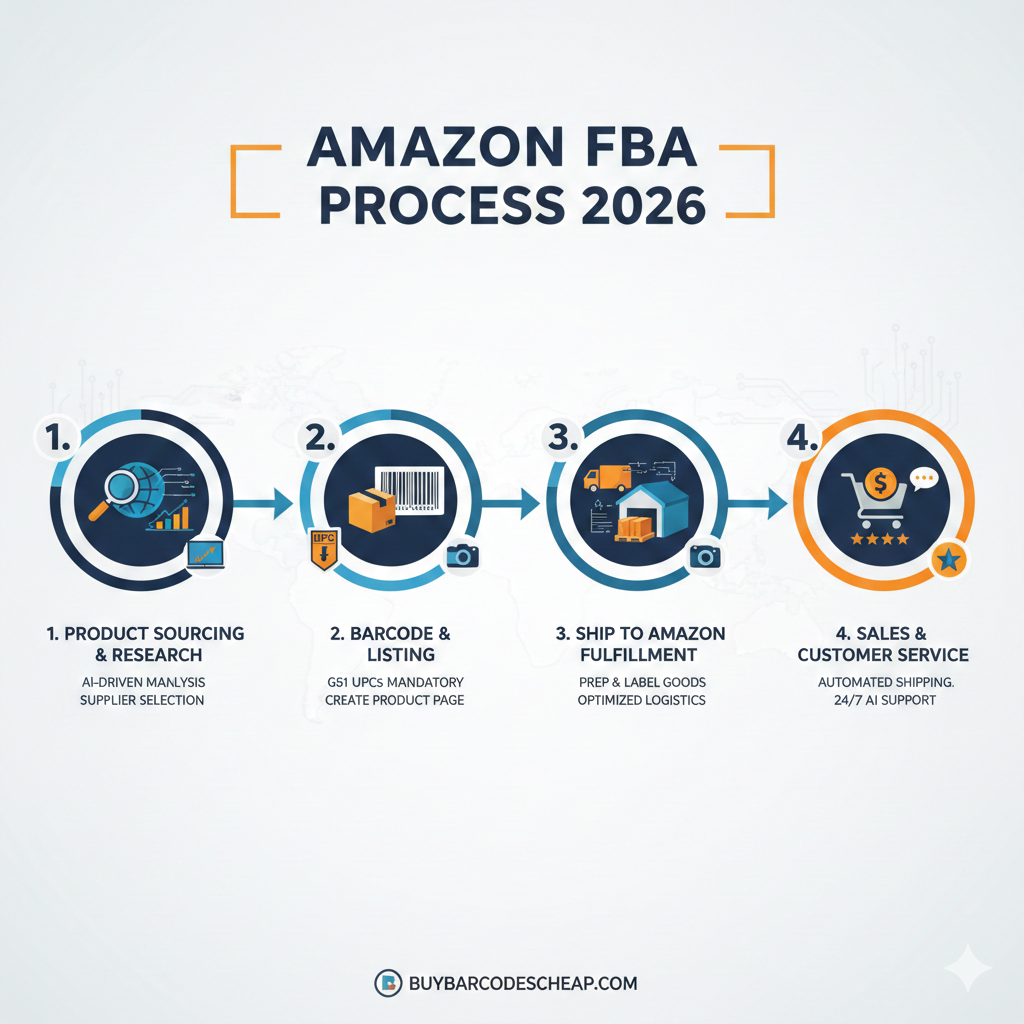
Amazon’s catalog system relies on standardized product identifiers. Sellers typically use UPC or EAN barcodes to uniquely identify products and minimize listing conflicts. Obtaining properly issued barcode numbers from reliable sources helps prevent registration errors and catalog issues.
Product Sourcing
Many Amazon FBA sellers source their products from Chinese manufacturers and ship them directly to Amazon warehouses in the United States. For this reason, platforms like Alibaba are commonly used when researching suppliers.
In reality, products can be manufactured in many countries. However, Chinese suppliers are often preferred due to competitive production costs and their extensive experience with private-label manufacturing.
One common strategy is to customize a product by adding your own logo or minor design changes. This helps differentiate your offer from competing listings. Simply selling a generic, unbranded product rarely creates a strong competitive advantage.
Another common approach is product customization. By working with your supplier, you can often add a logo or make small design adjustments to differentiate your product. The cost of simple logo printing or packaging customization is typically low, depending on the product and order volume. This small investment can significantly improve brand perception and competitiveness.
Logistics & Fulfillment
While the FBA model may appear straightforward, international logistics require careful planning. Shipping products from China to the United States involves production time, quality control, freight arrangements, customs clearance, and Amazon’s warehouse receiving process. As of 2026, inventory check-in times at Amazon fulfillment centers can vary and may take anywhere from several days to a few weeks, depending on location and seasonality.
Success with Amazon FBA is not determined solely by logistics but by product selection. Identifying a viable product with consistent demand, manageable competition, and healthy margins remains the most critical factor. Many new sellers hesitate due to perceived risks, which is natural in any business. However, product performance varies widely — some items gain traction quickly, while others require optimization and marketing adjustments.
Ultimately, Amazon FBA combines multiple elements, including product research, pricing strategy, listing optimization, advertising, customer experience, and competitive positioning. When executed correctly, it can be a scalable and rewarding business model.
One of the key advantages of the Amazon FBA model is automation. Once your products are stored in Amazon’s fulfillment centers, Amazon manages core operational tasks such as order processing, packaging, shipping, and customer service. This allows your business to continue running even when you are not actively working. Orders can be fulfilled at any time, while your earnings are tracked within your seller account.
AI Tools and Listing Optimization in 2026
As of 2026, artificial intelligence tools have become increasingly common in the Amazon selling ecosystem. Many sellers use AI-assisted solutions to help generate product titles, bullet points, and descriptions, as well as to analyze keywords and improve listing structure.
While AI tools can support efficiency and idea generation, successful listings still require human judgment. Factors such as accurate product representation, compliance with Amazon’s policies, and clear customer-focused messaging remain essential.
In practice, AI is best viewed as a productivity aid rather than a replacement for strategic decision-making. Sellers who combine AI tools with market research and optimization techniques often achieve more consistent results.
Managing Your Amazon FBA Business
Amazon sellers oversee all critical business activities through the Amazon Seller Central platform. This dashboard provides access to essential functions such as product listings, inventory monitoring, order management, payments, and performance metrics.
Seller Central serves as the operational hub for FBA businesses, allowing sellers to control and optimize their accounts from a single interface.
Receiving Payments as an Amazon FBA Seller
Amazon also provides multiple payout options for international sellers. As of 2026, many sellers use payment platforms such as Payoneer or Wise to receive funds. These services offer virtual bank account details that can be linked to your Amazon seller account, enabling you to withdraw earnings without needing a traditional US bank account. After configuring your payment information, Amazon transfers funds according to its standard payout schedule.
Like any business model, long-term success with Amazon FBA requires careful planning, realistic expectations, and accurate financial calculations. Consistent effort, informed decision-making, and ongoing optimization play a significant role in achieving sustainable results.
Barcodes and Product Identification for Amazon Sellers
When listing physical products on Amazon, proper product identification is essential. In many cases, marketplaces rely on globally recognized barcode systems such as UPC and EAN codes to distinguish products within their catalog.
For sellers building a private-label brand, obtaining legitimate barcode numbers becomes a necessary step before creating product listings. Choosing valid and properly formatted barcode identifiers helps prevent listing conflicts and supports smoother catalog integration.
Sellers who need barcode numbers should ensure they are obtained from a reliable provider. Our company supplies valid UPC and EAN barcode numbers with one-time pricing, no renewal fees, and fast processing. This allows Amazon sellers to secure product identifiers quickly and proceed with listing creation without delays.
Common Questions About Barcodes for Amazon FBA in 2026
Q: What does Amazon FBA mean?
A: FBA stands for “Fulfilled by Amazon,” where Amazon stores, packs, and ships your products.
Q: Is Amazon FBA suitable for beginners?
A: Yes. Many new sellers start with FBA due to Amazon’s logistics and fulfillment support.
Q: How do Amazon FBA sellers make money?
A: Sellers profit by sourcing products at a lower cost and selling them at a higher price on Amazon.
Q: Do I need to handle shipping with Amazon FBA?
A: No. Amazon manages order fulfillment, including packing and delivery to customers.
Q: What is the most important factor in FBA success?
A: Product selection and market research are widely considered the most critical elements.
Q: Do Amazon FBA products require a barcode?
A: In most cases, Amazon requires a unique product identifier such as a UPC or EAN code.
Q: Why are barcodes important for Amazon listings?
A: Barcodes help Amazon accurately identify, track, and manage products within its system.
Q: Where can sellers obtain barcode numbers?
A: Barcode numbers can be purchased from legitimate barcode providers. We supply valid UPC and EAN barcode numbers with simple one-time pricing.
Q: Can AI tools help optimize Amazon product listings?
A: Yes. Many sellers use AI-assisted tools to generate listing content, analyze keywords, and improve structure. However, human review remains important for accuracy and compliance.
Q: Does Amazon allow AI-generated listing content?
A: Amazon does not prohibit the use of AI tools, but sellers are responsible for ensuring that all listing information is accurate, policy-compliant, and not misleading.
Final Thoughts
Amazon FBA remains one of the most accessible e-commerce models for sellers seeking to leverage Amazon’s fulfillment and logistics infrastructure. While the operational framework simplifies many aspects of online retail, long-term success still depends on informed product selection, careful planning, and continuous optimization.
Like any business venture, realistic expectations, accurate cost analysis, and consistent refinement are essential. Sellers who approach the model strategically and adapt to marketplace dynamics are generally better positioned for sustainable outcomes.
About This Content
This article is informed by long-term familiarity with e-commerce marketplaces and ongoing observations of Amazon seller workflows. The content reflects common practices and concepts associated with the Amazon FBA model and is intended as an introductory overview rather than financial or business advice.
We hope this overview has helped clarify how Amazon FBA works and provided useful insights for those exploring the model.